Current to January 1, 2026
A plain reading of California Vehicle Code § 26708 and the sections attached to it. Quotations come from the text operative as of January 1, 2026 — § 26708 was last amended by Stats. 2025, Ch. 417.
The Default Rule Is No
Most tint charts present California as a list of allowed percentages per window. The statute is not written that way. § 26708(a)(1) opens with a flat prohibition:
“A person shall not drive any motor vehicle with any object or material placed, displayed, installed, affixed, or applied upon the windshield or side or rear windows.”
Everything legal is an exception carved out of that sentence: subdivision (b) lists the exemptions, (c) covers the windshield, (d) the front side windows, (e) clear medical film. The question is never how dark you can go — it is which exception a given piece of glass falls under.
This is about material applied to glass. Factory privacy glass is separate: § 26708.5(b) allows tinted safety glass that complies with the federal glazing standards and sits where those standards permit.
Front Side Windows: The Part Everyone Gets Wrong
There is no legal dark tint for the two windows beside the driver and front passenger. Not 35 percent, not 50. Under § 26708(d) the only material permitted there is “clear, colorless, and transparent material,” meeting all of the following:
- The material has a minimum visible light transmittance of 88 percent.
- The window glazing with the material applied meets all requirements of Federal Motor Vehicle Safety Standard No. 205 (49 C.F.R. 571.205), including the minimum light transmittance of 70 percent and AS–14 abrasion resistance.
- The material is designed and manufactured to enhance the ability of the existing window glass to block ultraviolet A rays.
- The driver keeps, in their possession or in the vehicle, a certificate signed by the installing company certifying compliance and identifying the installer and the film’s manufacturer by full name and street address.
- If the material tears or bubbles, or is otherwise worn to prohibit clear vision, it must be removed or replaced.
Those two numbers get mixed up constantly. The 88% belongs to the film alone. The 70% is the floor for the finished window — glass and film together — and it comes from the federal standard, not from California. Neither is permission to darken the glass to 70 percent: the film has to be clear and colorless before any number matters.
So aftermarket film cannot darken your front windows at all here. What it can add is a clear UV-blocking layer, plus the certificate proving it qualifies.
Behind The Driver: No Darkness Limit
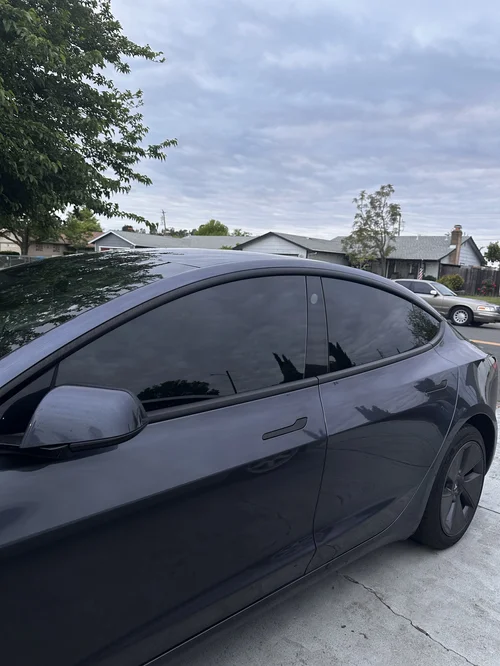
§ 26708(b)(4) exempts “side windows that are to the rear of the driver.” No percentage is attached, so rear side windows can go as dark as you want.
§ 26708(b)(8) exempts “the rear window or windows,” on one condition: the vehicle must have outside mirrors on both the left and right sides, positioned to show the driver at least 200 feet of highway to the rear through each mirror.
Nearly every modern vehicle already satisfies that. It is still a real condition — a blacked-out rear window on a car with a broken or missing passenger mirror loses the exemption it depends on.
The Windshield: 29 Inches, Not Four
Almost every California tint page calls this “the top four inches.” That figure is not in the Vehicle Code. § 26708(c) permits transparent material on “the topmost portion of the windshield” where:
- The bottom edge of the material is at least 29 inches above the undepressed driver’s seat, measured from a point five inches in front of the bottom of the backrest, with the seat in its rearmost and lowermost position and the vehicle on a level surface.
- The material is not red or amber in color.
- There is no opaque lettering, and any other lettering does not affect primary colors or distort vision through the windshield.
- It does not reflect sunlight or headlight glare into the eyes of occupants of oncoming or following vehicles to any greater extent than the windshield without it.
The four-inch shorthand survives because on many sedans a four to five inch band lands above that line. It approximates the rule; it is not the rule. The measurement starts at the seat, not at the top of the glass, so seat height, seat travel and windshield rake all move it. We measure it on the car before cutting anything.
Film across the entire windshield is a separate question — the only route § 26708 provides for that is subdivision (e), below.
Reflective And Mirrored Film
For the windshield band, § 26708(c)(4) is a comparison rather than a percentage: the material must not throw sun or headlight glare into other drivers’ eyes any more than the bare windshield would.
For medical sun screening devices, § 26708.2(d) does set a hard number — no reflective quality exceeding 35 percent on either the inner or outer surface.
Outside those two provisions, § 26708 states no general reflectance percentage for ordinary rear glass. Mirrored and metallic films remain bound by § 26708.5(a), which prohibits applying any transparent material that alters the color or reduces the light transmittance of the windshield or side or rear windows except as § 26708 allows. For a defensible figure on a specific film, use the manufacturer’s spec sheet.
Medical Exemptions: Two Routes
Two exist, they work differently, and neither one permits dark front glass.
1. Removable sun screening devices — § 26708(b)(10)
A driver or front-seat passenger may use sun screening devices on the front side windows while carrying a letter signed by a licensed physician and surgeon certifying they must be shaded from the sun due to a medical condition, or one signed by a licensed optometrist certifying a visual condition. § 26708.2 defines the device:
- Held so it can be readily removed — a frame, rigid material with temporary fasteners, or a flexible roller shade.
- If transparent: green, gray or neutral smoke, with luminous transmittance of not less than 35 percent.
- If louvered: an essentially uniform pattern, at least 35 percent open area, no individual louver or opaque section taller than 3/16 inch.
- No reflective quality exceeding 35 percent on either surface.
They may not be used during darkness. Note the wording — this is a device you can lift out of the window, not a film bonded to it.
2. Clear UV film — § 26708(e)
Clear, colorless and transparent film on the windshield, side or rear windows, on the same specifications as subdivision (d), where the driver carries a certificate signed by a licensed dermatologist certifying that the person should not be exposed to ultraviolet rays because of a medical condition. Clear again: a dermatologist’s certificate does not authorize dark tint on front glass.
How It Is Enforced
A § 26708 violation is an equipment infraction, and Division 12 equipment infractions are correctable under § 40303.5(e). The officer is to permit a notice to correct — the fix-it ticket — unless a disqualifying condition in § 40610(b) applies: fraud or persistent neglect, an immediate safety hazard, or a driver who will not or cannot promptly correct it. From there:
- The notice states a reasonable time to correct, not to exceed 30 days (§ 40610(d)).
- Proof of correction may be certified by a police department, the CHP, a sheriff, a marshal or another agency regularly enforcing the Vehicle Code (§ 40616(c)).
- The clerk collects a 25 dollar transaction fee for each violation (§ 40611(a)).
- On timely proof of correction, the court dismisses the charge (§ 40522).
- Willfully failing to deliver proof of correction is a misdemeanor (§ 40616).
Base fines and the assessments stacked on them vary by court and county, so we will not quote a total — the figure on your own notice is the one that counts.
One more piece: § 26708.5(a) makes it unlawful to install the non-compliant material in the first place. That runs to the installer, not only the driver, which is why a shop that knows the code declines to put 20 percent film on your front doors.
What This Means When You Choose A Shade
A compliant job on a daily driver looks like this: rear sides and rear window take whatever shade you want, the front sides get nothing or clear UV film with its certificate, and the windshield gets a measured band at the top.
For looks, that is restrictive. For comfort it matters less than people expect, because heat is not a darkness problem. Infrared rejection is what keeps a cabin cool, and it is a different property from visible darkness. Our ceramic film blocks 99% of UV and rejects up to 88% of infrared heat; our carbon film also blocks 99% of UV. A lighter ceramic film on the front doors can outperform a darker budget film.
Carbon starts at $300 and ceramic at $380 for a full vehicle, three to four hours in the bay. The window tint page puts the specs side by side. Or tell us the year, make and model and request a quote — we will confirm what is legal on your car before you pick a shade, so nothing gets installed that you have to pay to remove.
One Necessary Disclaimer
This page summarizes and quotes the California Vehicle Code as we read it, current to January 1, 2026, to help you choose a film. It is not legal advice, statutes get amended, and enforcement varies between agencies. If you are dealing with a citation, read the current text of § 26708 on the California Legislative Information site, or speak with an attorney.